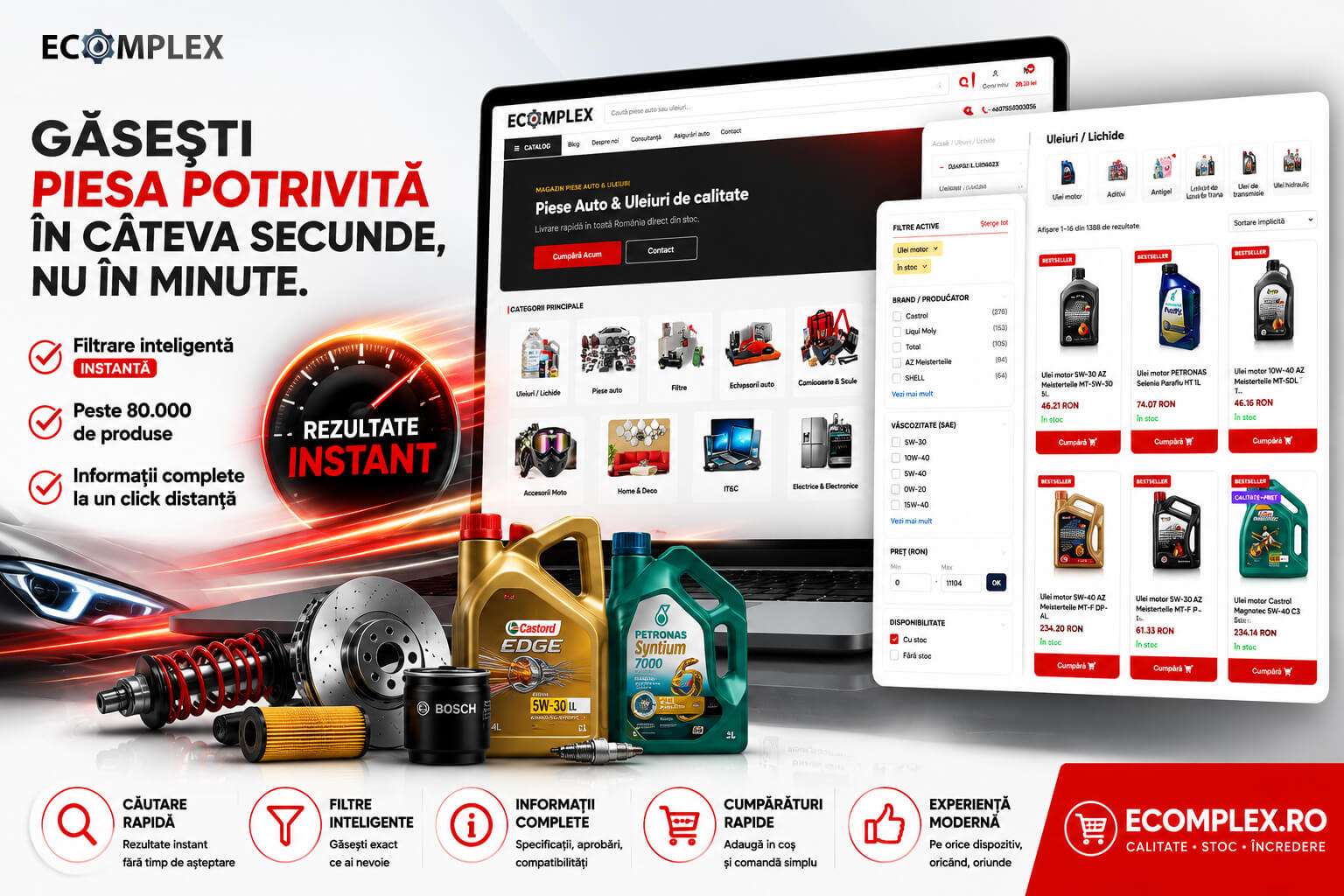
Between 2023 and 2026, ecomplex.ro evolved from a simple WooCommerce MVP with just 3,000 automotive products into a highly optimized platform serving more than 80,000 SKUs. This transformation was not achieved through platform migration, but through continuous engineering, infrastructure optimization, automation, and carefully replacing every architectural bottleneck.
Every successful eCommerce platform eventually reaches the same turning point.
During the early stages, the priority is validating the business. Speed matters more than perfection, and launching quickly is often a better investment than building a perfect technical architecture.
That was exactly the philosophy behind the first version of ecomplex.ro.
Launched in 2023, the platform was designed to validate an automotive eCommerce business while supporting the daily operations of a physical showroom. Instead of spending months building a custom application, we deliberately chose a proven technology stack consisting of WordPress, WooCommerce, and a commercial theme.
The goal was never to build the final platform. The goal was to learn.
Over the following three years, every customer interaction, every supplier integration, every slow query, and every operational bottleneck became valuable engineering data.
Rather than replacing the platform when limitations appeared, we analyzed them, measured them, and replaced individual architectural bottlenecks one by one.
Today, ecomplex.ro manages a catalog of more than 80,000 automotive products while running on a heavily customized WordPress and WooCommerce architecture featuring OpenSearch, Redis, enterprise integrations, advanced automation, and a completely rebuilt frontend.
This document tells the story of that evolution.
Looking back, the transformation of ecomplex.ro can be divided into four distinct engineering phases. Each phase introduced different technical challenges and required a different approach. Rather than attempting a complete rewrite from the beginning, the platform evolved organically as the business itself matured.
The first version of ecomplex.ro was intentionally simple. The technology stack consisted of:
At launch, the online store contained approximately 3,000 products.
Rather than investing significant resources into custom development, we focused on validating the business itself. The primary objectives were:
The architecture was intentionally lightweight because business validation was considered more valuable than technical perfection.
Looking back, this proved to be one of the most important engineering decisions of the entire project. Instead of building software based on assumptions, we built software based on real operational experience.
"Premature optimization is rarely an investment. Validating the business first allowed every future engineering decision to be based on real operational data rather than assumptions."
During 2024, the product catalog expanded from approximately 3,000 to more than 13,000 products.
This growth exposed the first architectural bottlenecks. Page generation became slower. Database queries became heavier. Taxonomy calculations increased. Administrative operations required more manual work. SEO complexity increased significantly.
Rather than replacing WooCommerce, we decided to understand where those bottlenecks actually existed. Every optimization started with measurement rather than assumptions.
"Replacing software without measuring it first rarely solves the real problem."
Rather than making assumptions, we began analyzing the application layer by layer, measuring database query execution times, taxonomy calculations, attribute relationships, page generation times, Google crawl behaviour, and structured SEO signals.
One of the first infrastructure improvements was introducing Redis Object Cache.
WooCommerce repeatedly resolves identical objects such as products, attributes, categories, metadata, and settings. Without object caching, MySQL performs the same expensive operations during every request. Redis moved these frequently requested objects into memory.
The result was lower database load, reduced page generation time, improved backend responsiveness, and better scalability under concurrent traffic.
Managing automotive catalogs manually does not scale. Thousands of products, attributes, brands, and taxonomies quickly become impossible to maintain without automation.
To solve this problem, we developed custom PHP utilities capable of synchronizing taxonomies, updating attributes, cleaning inconsistent relationships, and executing bulk administrative operations safely. Instead of spending hours maintaining data manually, software became responsible for maintaining consistency.
As the catalog continued growing, SEO became a technical engineering challenge rather than a content challenge. We introduced strategic noindex policies, crawl budget optimization, canonical improvements, search index cleanup, and category hierarchy refinements.
By the end of 2025, the catalog had grown to approximately 40,000 products. At this stage, the primary bottleneck was no longer website performance. It was operational complexity.
Supplier updates became more frequent, pricing rules became increasingly sophisticated, and manual administrative work consumed valuable time. Instead of hiring additional personnel to perform repetitive work, we chose to automate it.
"If a process has to be performed twice, it should probably be automated."
Using a combination of PHP and Python, we developed multiple automation services responsible for product pricing, supplier synchronization, business rule execution, and scheduled catalog updates. PHP handled WordPress hooks, while Python processed large datasets and catalog calculations in standalone background workers.
As operations became increasingly interconnected, we expanded WooCommerce beyond its native capabilities:
We performed extensive analysis of core WooCommerce workflows (queries, hooks, filters, template rendering). This investigation revealed that many perceived WooCommerce limitations were actually implementation details rather than engine bottlenecks, which redirected our next phase.
At the beginning of 2026, the catalog exceeded 80,000 products. Conventional wisdom suggested WooCommerce was at its limit, and we seriously considered migrating to another eCommerce platform.
However, our analysis led to a different conclusion. WooCommerce wasn't the biggest problem. The surrounding architecture (commercial theme, SQL-driven filtering, and heavy catalog joins) was. Instead of migrating, we chose to rebuild the platform piece by piece.
"The more we analyzed, the more one conclusion became obvious: our biggest bottlenecks weren't caused by WooCommerce. They were caused by everything built around it."
The bloated commercial theme was completely removed and replaced with a custom, lightweight theme designed around the operational requirements of ecomplex.ro. Practically every component (homepage, product page, category filtering, design system) was rebuilt from scratch.
Rebuilt JSON-LD structured data, Schema.org mappings, semantic HTML tags, Core Web Vitals pathways, and optimized CSS/JavaScript code delivery.
Automotive catalog browsing relies on complex combinations of filters (manufacturer, engine, viscosity, dimensions, compatibility). With 80,000+ products, relational SQL joins became extremely slow, causing certain category pages to require 70–80 seconds to load.
We integrated **OpenSearch** as the primary index. We built a custom indexing pipeline and synchronized catalog attributes. Today, complex category filtering operations execute in milliseconds rather than minutes.
Today's platform includes:
The layer-by-layer optimization approach transformed the technical capabilities of the shop without requiring a risky database migration:
| Component | 2023 | 2026 |
|---|---|---|
| Product Catalog | ~3,000 | 80,000+ |
| Theme | Commercial Envato Theme | Fully Custom Theme |
| Search Engine | Native WooCommerce Search | OpenSearch |
| Product Filtering | SQL-based | Custom OpenSearch Engine |
| Category Performance | Standard WooCommerce | Millisecond-level Filtering |
| Object Cache | Default | Redis |
| Product Management | Mostly Manual | Automated PHP & Python Workflows |
| Newsletter | Third-party Services | Mailcow + Listmonk |
| Invoice Management | Manual | Oblio Integration |
| Shipping | Standard WooCommerce | Sameday API |
| Technical SEO | Basic | Enterprise-Level Implementation |
| Architecture | Standard WooCommerce | Enterprise-Oriented Platform |
Looking back, this project reinforced several engineering principles that now guide how we approach every large-scale eCommerce project:
The evolution of ecomplex.ro demonstrates that scalability is not determined solely by the platform you choose. It is determined by the engineering decisions you make as your business grows.
Over three years, we transformed a standard WooCommerce installation into a highly customized enterprise eCommerce platform—not by replacing everything at once, but by continuously measuring, optimizing, automating, and evolving every architectural layer.
From approximately 3,000 products to more than 80,000, every stage of growth introduced new challenges, new lessons, and new opportunities to improve the platform. The result is not simply a faster online store. It is an engineering-first platform designed to continue evolving alongside the business it supports.